Healthcare Software
ProfilBuddy.
A healthcare-oriented digital platform designed to organize digital information capture and operational workflows.
- Creativity Coder
- Client-delivered
- Collaborative
02
Overview
ProfilBuddy is a digital forms platform and operator workbench for healthcare teams — clinics, hospitals and diagnostic labs.
It replaces paper clipboards, WhatsApp threads and spreadsheets with one structured intake flow and role-based dashboards for receptionists, doctors and lab technicians.
- Context
- Creativity Coder · Client-delivered · Collaborative
- Client
- ProfilBuddy
- Built with
- Hitarth Shah
- Contribution
- Creativity Coder engagement — architecture, backend and data focus.
- Stack
Next.js 15/React Server Components/TypeScript/Schema validation/Role-based access control
03
Problem
Patient intake was spread across WhatsApp threads, Excel files and paper forms. Patient data, doctor approvals and operational records sat in tools never designed to hold them — creating confidentiality risk and multi-hour processing delays.
04
Goals & requirements
- 01
Strict confidentiality and clinical-record privacy.
- 02
An interface non-technical reception staff can use with no training.
- 03
Reliable submissions on unstable hospital Wi-Fi and cellular networks.
- 04
Fast form rendering during high-volume morning outpatient peaks.
05
My role & contribution
Delivered through Creativity Coder together with co-founder Hitarth Shah — this is shared studio work, not a solo build.
Within the studio my focus is systems architecture, backend logic, Next.js infrastructure and database design; Hitarth leads interface engineering and client workflows.
06
Technical architecture
Forms are streamed from the server, validated at the edge before they reach the database, and written through an idempotent pipeline. Every read is filtered by role.
- 01Operators
- Reception
- Doctors
- Lab technicians
- 02Application
- Next.js Server Components
- Role-based dashboards
- 03Guardrails
- Edge schema validation
- Idempotency keys
- Permission tiers
- 04Data
- Central clinical records
- Audit trail
07
Technology stack
- Next.js 15
- React Server Components
- TypeScript
- Schema validation
- Role-based access control
08
Engineering decisions
- 01
Server Components for forms
Forms are streamed from the server, keeping the client bundle light on the low-end devices common at front desks.
- 02
Validate at the edge
Strict schemas reject malformed input before it reaches the primary database.
- 03
Idempotent submissions
Requests carry idempotency keys, so a double-tap or a network retry can never create a duplicate patient record.
- 04
Role-based access governance
Doctors, receptionists and billing staff each see only the fields their role requires.
09
Development challenges
- 01
Unreliable networks
Basements and crowded wards mean retries are normal — the write path had to be safe to repeat.
- 02
Zero learning curve
Reception staff work under time pressure; every extra field or step is a cost.
- 03
Privacy by construction
Confidentiality had to be enforced by the data model and permissions, not by convention.
10
Interface details
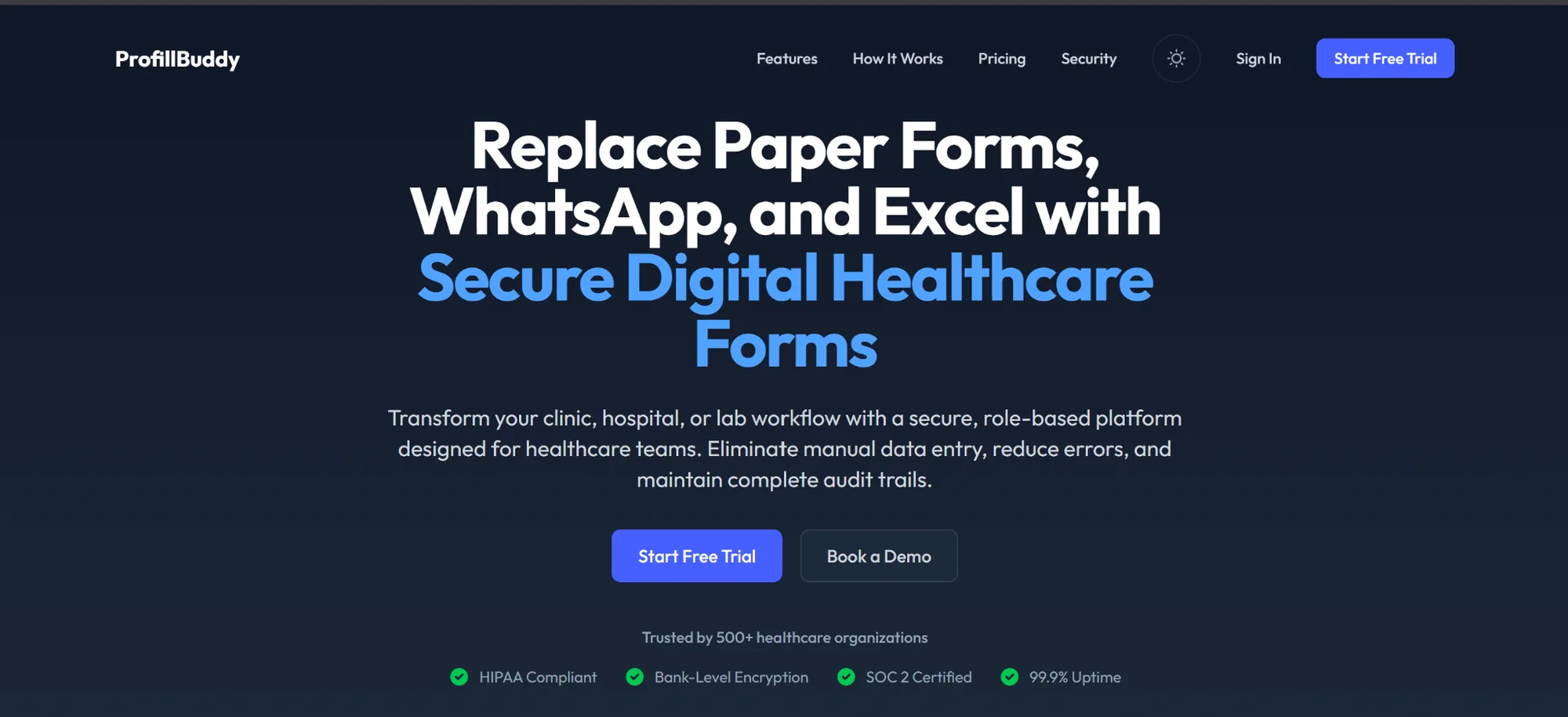
The public landing page of the production platform, positioning the product around replacing paper, WhatsApp and Excel workflows.
Magnified details of: ProfilBuddy landing page headline: Replace paper forms, WhatsApp and Excel with secure digital healthcare forms
11
Final implementation
ProfilBuddy is live in production at profillbuddy.com.
12
Results & lessons
- Lighthouse performance
- 98
- Active clinical users
- 1,200+
- Time to first byte
- <400ms
Lessons
- 01
In unreliable environments, idempotency is a product feature — a duplicate patient record is a real-world problem, not just a data bug.
- 02
Permissions are easiest to get right when they are designed from what each role actually does during a shift.
13–14
Project links
- 13Live projectprofillbuddy.com(opens in a new tab)
- 14Source codePrivate — client codebase