Digital Dining Experience
Amaya Café.
A digital dining experience designed around menu presentation, brand identity and customer discovery.
- Creativity Coder
- Client-delivered
- Collaborative
02
Overview
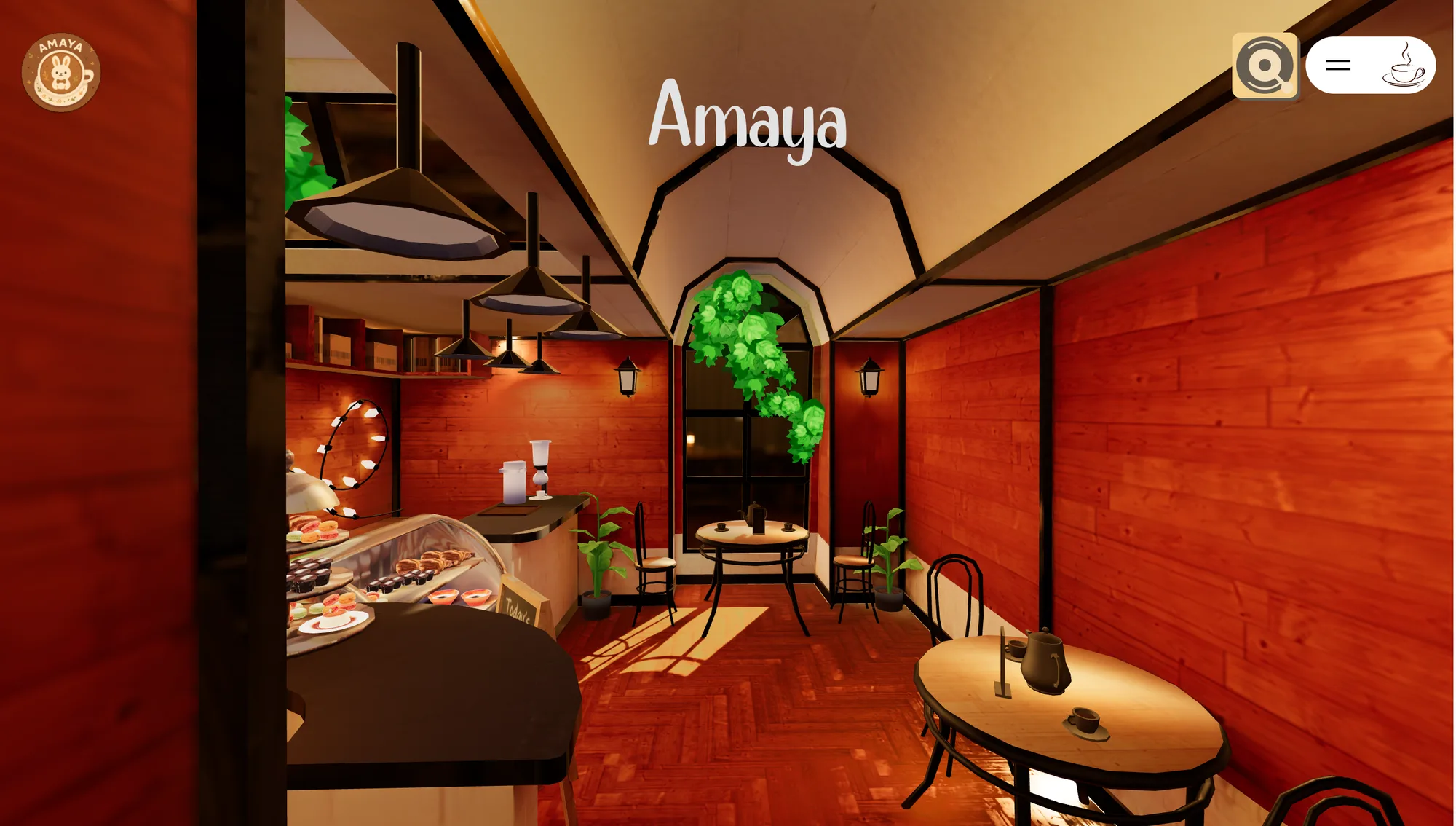
Amaya Café's digital presence starts inside the café: a real-time 3D interior that sets the brand's tone before the menu even opens.
Behind it sits a menu experience built for the people actually using it — guests on their phones, at the table.
- Context
- Creativity Coder · Client-delivered · Collaborative
- Client
- Amaya Café
- Built with
- Hitarth Shah
- Contribution
- Creativity Coder engagement — collaborative build.
- Stack
React 19/Vite/Three.js/React Three Fiber/Drei/GSAP/Tailwind CSS
03
Problem
The café relied on heavy PDF menus that failed to load on mobile connections, and on generic aggregator links that diluted the brand. Guests gave up before the menu opened.
04
Goals & requirements
- 01
Designed for phones first — nearly all visits happen on mobile, inside the venue.
- 02
Usable on weak indoor cellular connections.
- 03
Rich food imagery without bloated page weight.
- 04
Instant category filtering across brews, bakery, mains and desserts.
05
My role & contribution
Delivered through Creativity Coder together with co-founder Hitarth Shah — this is shared studio work, not a solo build.
Within the studio my focus is systems architecture, backend logic, Next.js infrastructure and database design; Hitarth leads interface engineering and client workflows.
06
Technical architecture
A Vite-built React application with a React Three Fiber scene for the brand space and a cached, client-side menu for instant category switching.
- 01Guest
- Mobile browser at the table
- 02Experience
- 3D café scene (R3F)
- GSAP transitions
- 03Menu
- Category navigation
- In-memory catalogue cache
- 04Assets
- AVIF / WebP pipeline
- Reserved image dimensions
07
Technology stack
- React 19
- Vite
- Three.js
- React Three Fiber
- Drei
- GSAP
- Tailwind CSS
08
Engineering decisions
- 01
A space, not a document
A 3D interior replaces the PDF as the front door — the brand is experienced, not downloaded.
- 02
Cache the catalogue once
Menu items are held in client state after the first load, so switching categories needs no further network round-trips.
- 03
Modern image formats with reserved space
AVIF/WebP assets with pre-computed dimensions keep imagery sharp without layout shift.
- 04
Motion tuned for touch
GPU-friendly transforms and micro-interactions sized for one-handed use.
09
Development challenges
- 01
3D on a phone, on 4G
A real-time scene had to coexist with a menu that must open instantly on a weak connection.
- 02
Imagery vs. weight
Food photography sells — but every image competes with load time.
10
Interface details
The landing view of the production site: the café interior rendered in real time, with the menu entry in the top-right corner.
Magnified details of: Amaya Café website: a warmly lit 3D café interior with wooden walls, pendant lamps, a pastry counter and small round tables
11
Final implementation
Amaya Café is live at amaya-sable.vercel.app.
12
Results & lessons
- Session time
- 3.2×
- Menu fetch
- <1s
- Cumulative layout shift
- 0.00
Lessons
- 01
Immersive and fast are not opposites — they just have to be budgeted separately.
- 02
Designing for the real context of use (a phone, at a table, on weak signal) removes most debates before they start.